The Ultimate Kilimanjaro Packing List
What to actually put in your duffel, layer by layer, for a mountain that runs from rainforest heat to arctic cold in under a week.
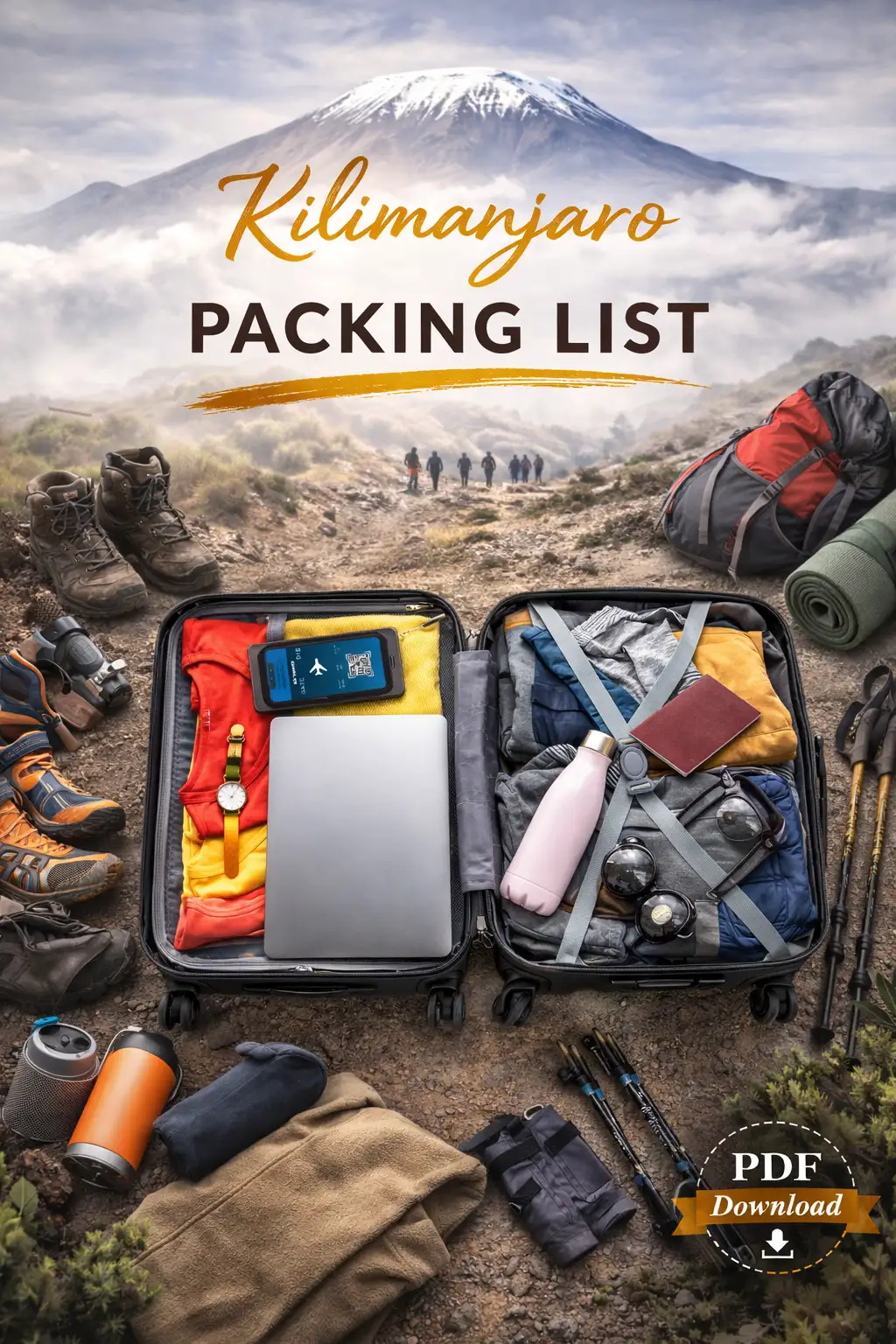
Gear laid out and checked the night before departure — the last chance to catch anything missing.
Kilimanjaro is climbed on foot, with no ropes and no technical gear. But the mountain crosses five climate zones in under a week — from rainforest heat at the gate to arctic cold at the summit. A good Kilimanjaro packing list has to cover that whole range in one duffel bag. That's why so many first-time climbers either overpack out of worry, or underpack because they don't know what the upper mountain really demands.
This guide is the full kilimanjaro equipment list Climb and Sum It Africa gives every climber before departure. It covers clothing layers, footwear, your sleep system, daypack essentials, documents, and the small extras that matter most on summit night. It also covers what to rent in Moshi, what to buy at home, and what to leave out of your bag completely.
For route-specific planning, read the Kilimanjaro routes guide. For climate and timing, the best time to climb Kilimanjaro guide explains how season affects your kit, and the altitude sickness guide covers the physical side of the climb. If you're also working out your budget, the Kilimanjaro climb cost guide breaks down what's usually included.
Every item on this page, plus visa, health, tipping and gear-hire details, in one printable guide.
Pack every layer to be worn at once on summit night: base, mid, insulated puffer, waterproof shell, warm hat, buff, liner gloves under mittens. Everything else on this list supports those core pieces.
Building a Layering System
The best way to think about a Kilimanjaro clothing list is in layers, not bulk. Climbers move through rainforest heat, cool moorland, cold alpine desert, and a summit night far below freezing — sometimes all in the same 24 hours. A layering system you can add to or strip away works far better than a few heavy, fixed items. This is the base of any solid Kilimanjaro trekking gear list.
Base Layer
- Moisture-wicking synthetic or merino wool — never cotton
- Worn against the skin every day of the climb
- 2–3 tops and bottoms for rotation
- Merino resists odour better on multi-day treks
Mid Layer
- Fleece jacket for moorland and camp evenings
- Softshell trousers for daytime hiking
- Traps warmth without restricting movement
- Add or remove as the trail climbs and descends
Insulation Layer
- Down or synthetic puffer for camp and summit night
- Packs small, warms fast — the single most important piece
- Insulated trousers or thermal leggings underneath
- Rated well below freezing
Waterproof Shell
- A genuine waterproof jacket and trousers, not showerproof
- Needed for rainforest downpours and upper-mountain wind
- Breathable, taped seams, roomy over insulation
- Non-negotiable regardless of season
The Complete List, Category by Category
Upper Body
The torso needs the most versatile layering of any body part, since it swings from sweating on the rainforest days to needing serious insulation on summit night. Pack enough base layers to rotate without needing to wash mid-trek — laundry isn't realistic once above the lower camps. Avoid cotton T-shirts entirely; cotton holds moisture against the skin, which becomes a real risk once evening temperatures drop.
- Moisture-wicking T-shirts — 2 to 3
- Long-sleeve base layer tops — 2
- Fleece jacket — 1
- Softshell jacket — 1
- Down or synthetic puffer jacket — 1
- Waterproof shell jacket — 1
Lower Body
Legs generate more heat from movement than the upper body, so daytime trekking trousers can be lighter than most climbers expect. The exception is summit night, when slow, cold movement makes thermal leggings under trekking trousers, plus a waterproof outer layer, essential rather than optional.
- Trekking trousers — 2
- Thermal leggings — 1 to 2
- Waterproof trousers — 1
- Moisture-wicking underwear — 6 to 8
- Shorts for the lower rainforest days — optional
Head, Hands & Neck
Frostbite risk on Kilimanjaro concentrates in the extremities — fingers, toes, ears, nose — during the pre-dawn summit push, when temperatures and wind chill are at their worst and climbers are moving slowly. This is the category most first-time climbers underestimate, bringing one pair of gloves when a layered system performs far better. A buff or neck gaiter is one of the lightest, cheapest items on the whole list and does more for summit-night comfort than almost anything else.
- Sun hat or cap — 1
- Warm insulated hat — 1
- Buff or neck gaiter — 1 to 2
- Liner gloves — 1 pair
- Insulated waterproof mittens — 1 pair
- UV-protective sunglasses — 1
Footwear & Socks
Boots are the item most likely to end a climb early if chosen or broken in poorly. Waterproof, ankle-supporting hiking boots that have already covered at least 50–80km of trekking before the trip are the standard recommendation — new boots on the mountain are one of the most common causes of blisters severe enough to affect summit-day performance. Sock layering matters almost as much as the boot itself: a thin liner sock plus a thicker hiking sock reduces friction and manages moisture far better than one thick pair.
- Waterproof hiking boots, broken in — 1 pair
- Wool-blend hiking socks — 4 to 5 pairs
- Liner socks — 3 to 4 pairs
- Camp shoes or sandals — 1 pair
- Gaiters, useful in wet season or snow — optional
Sleep System
A four-season sleeping bag rated to at least -10°C is the standard recommendation, and -15°C is a safer margin for the higher camps, where overnight temperatures fall below freezing well before the summit push even begins. A sleeping bag liner adds several degrees of warmth and keeps the bag cleaner over the trek. An insulated sleeping mat matters just as much as the bag — cold rises from frozen ground overnight, and a poor mat undoes much of what a good bag provides.
- Sleeping bag rated -10°C to -15°C — 1
- Sleeping bag liner — 1
- Insulated sleeping mat — 1
- Inflatable travel pillow — optional
Daypack & Trekking Gear
Porters carry the main duffel between camps, but each climber carries their own daypack — typically 30–40 litres — with water, snacks, layers, a camera, and any personal medication needed during the day's walk. A hydration bladder is worth using alongside water bottles, since it encourages more frequent sipping, which helps with acclimatisation. Trekking poles are optional but genuinely useful on the steep, loose scree of the summit-night descent, where they reduce strain on the knees considerably.
- Daypack, 30–40 litres — 1
- Water bottles or hydration bladder, 3 litre capacity — 1 set
- Headlamp with spare batteries — 1 plus spares
- Trekking poles — recommended
- Duffel bag, porter-carried, 90–100 litres, waterproof — 1
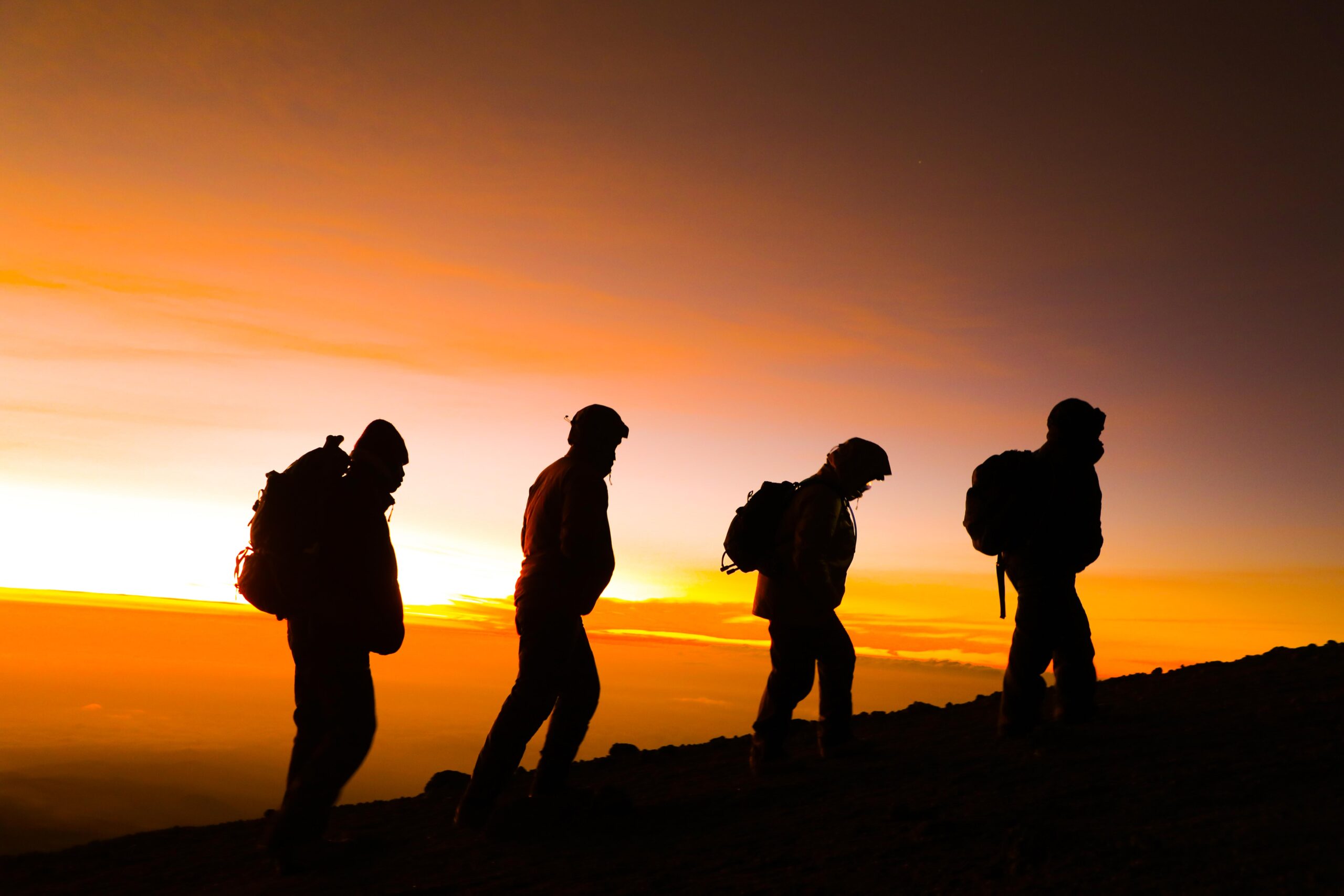
Summit night — every layer worn at once, headlamps on, moving at "pole pole" pace in the pre-dawn cold.
Christopher can talk you through the full kit list and what Climb and Sum It Africa can provide as rental gear in Moshi before your climb.
Toiletries, Health & Documents
Beyond clothing and sleep gear, a few categories are easy to overlook until the night before departure.
| Category | Item | Priority | Notes |
|---|---|---|---|
| Health | Personal first-aid kit | Essential | Blister plasters, painkillers, personal medication |
| Health | Altitude medication (e.g. Diamox) | Recommended | Discuss dosage with a doctor before travel |
| Health | Sunscreen SPF 50 and lip balm with SPF | Essential | UV exposure is intense at altitude near the equator |
| Health | Hand sanitiser and wet wipes | Essential | Limited washing facilities above lower camps |
| Health | Rehydration salts | Recommended | Useful for appetite loss at altitude |
| Documents | Passport and Tanzania e-Visa printout | Essential | Passport needs 6 months' validity remaining |
| Documents | Travel insurance with high-altitude cover | Essential | Confirm cover extends to at least 6,000m |
| Documents | Yellow fever certificate | Conditional | Required if arriving from a listed country |
| Money | Cash — USD and TZS | Essential | USD notes must be series 2003 or newer |
| Extras | Power bank and universal adapter | Essential | No charging above the lower camps on most routes |
| Extras | Energy bars and electrolyte tablets | Recommended | Useful supplement to camp meals on summit night |
| Extras | Earplugs | Recommended | Tent camps can be noisy |
| Extras | Dry bags or packing cubes | Recommended | Keeps duffel contents organised and dry |
Packing by Altitude Zone
Kilimanjaro crosses five ecological zones between the gate and the summit, and what's actually needed changes noticeably at each stage. Thinking in zones, rather than packing everything for every day, makes it easier to know what stays accessible in the daypack versus buried in the duffel.
Rainforest · 1,800–2,800m
- Lightweight, breathable clothing
- Waterproof jacket kept at the top of the daypack
- Insect repellent
- Gloves not yet needed
Moorland · 2,800–3,500m
- Mid-layer fleece for cooler days
- Sun protection — UV increases sharply
- Warm layer for camp evenings
- Wide-brimmed hat in open terrain
Alpine Desert · 3,500–4,500m
- Full insulation for camp mornings and evenings
- Warm hat and liner gloves in regular use
- Large day-to-night temperature swings
- Wind protection matters more than rain here
Summit Zone · 4,500m+
- Every layer worn at once for the night ascent
- Insulated mittens, buff and headlamp are essential
- -15°C to -20°C with wind chill is typical
- Hand and toe warmers are worth adding
What to Rent vs What to Bring
Not everything on a Kilimanjaro kit list needs to be bought new. Bulky, expensive gear that won't be used again — a four-season sleeping bag, insulated mountaineering mittens, gaiters — can usually be hired in Moshi at a fraction of retail cost, which keeps luggage lighter and avoids buying gear for a single trip. Typical hire rates run from around $10 for gloves or gaiters to $30 per trip for a sleeping bag, boots, or a waterproof duffel.
Always bring your own
- Hiking boots — fit and break-in are personal
- Base layers and socks — worn against skin for days
- Headlamp — familiarity matters on summit night
Worth hiring in Moshi
- Sleeping bag and sleeping mat
- Insulated mittens and gaiters
- Trekking poles and waterproof duffel
Climb and Sum It Africa keeps a stock of well-serviced sleeping bags, mats and cold-weather accessories on request. Confirm hire needs when booking so equipment can be checked before the trek begins.
What Not to Bring
Keep the duffel lean. Cotton clothing of any kind holds moisture and increases hypothermia risk once wet — leave it at home. Heavy jeans, full-size toiletries, hardback books and multiple changes of "town clothes" all add weight that porters carry and climbers rarely use. Climb and Sum It Africa, like most operators, caps porter-carried duffel weight at 18kg per climber to protect crew health — packing efficiently isn't just about comfort, it keeps the trek within fair-carrying-weight limits.
Christopher can review your packing list against your route and season and flag anything missing before you fly.
Frequently Asked Questions
What is the most important item on a Kilimanjaro packing list?
A warm, reliable insulation layer (down or synthetic puffer) combined with a properly rated sleeping bag matters more than any single other item. Together they cover the two coldest, most demanding parts of the climb — summit night and sleeping at high camps.
How cold does it get on Kilimanjaro, and what should I pack for summit night?
Temperatures at Uhuru Peak commonly fall between -15°C and -20°C with wind chill during the pre-dawn summit push. Wear every layer at once: base layer, mid layer, insulated puffer, waterproof shell, insulated trousers, warm hat, buff, liner gloves under insulated mittens, and warm socks inside broken-in boots.
Can I hire gear in Tanzania instead of buying everything at home?
Yes. Bulky or specialist items — sleeping bags, mats, insulated mittens, gaiters, trekking poles — are commonly available to hire in Moshi at a fraction of retail cost. Climb and Sum It Africa keeps hire stock for climbers who prefer not to travel with this equipment; confirm needs at the time of booking.
How many kilograms can my porter carry, and does that affect my packing list?
Climb and Sum It Africa caps porter-carried duffel weight at 18kg per climber, in line with fair-carrying-weight standards for mountain crew. That's a generous allowance for a well-planned list, but it rules out multiple changes of casual clothing, full-size toiletries, or heavy non-essentials.
Do I need mountaineering boots, or will regular hiking boots work?
Standard Kilimanjaro routes don't require technical mountaineering boots or crampons. A sturdy, waterproof, ankle-supporting hiking boot broken in well before the trip is the right choice for all six standard routes.
What should I pack differently for a rainy-season climb?
Priority shifts toward waterproofing: a genuinely waterproof jacket and trousers, gaiters, dry bags inside the duffel, and an extra set of dry base layers for camp. See the best time to climb Kilimanjaro guide for a month-by-month breakdown of rain patterns.